The next queue at your research center isn’t for compute.
Walk into any research computing center and you’ll find a queue. Jobs wait for nodes. Allocations get fought over at the start of every cycle. Everyone accepts it, because that’s how a shared supercomputer works.
A second queue is forming next to it, and it’s quieter. It’s the line of researchers waiting to run AI models on their own data.
A genomics group wants findings pulled out of 40,000 papers. A materials lab wants cited answers from its own instrument logs. A social science team wants every interview transcribed and searchable. None of these is a supercomputing job. All of them need a GPU. And most of them can’t send the data to a hosted API, because it’s unpublished, export-controlled or attached to a patient.
So they wait. Or they build a rig under a desk.
The problem isn’t model size. It’s model count.
Most research AI isn’t one giant model. It’s a set of mid-sized models, each doing one part of a job. One sorts. One extracts. One drafts. One checks the draft. Agentic workflows push this further: Futurum, a leading industry analyst firm, estimates they use 10 to 100 times more tokens per task than a single inference call.
That changes the sizing question. You stop asking “how big a model can we run?” and start asking “how many models need to run at the same time?”
The standard GPU server wasn’t built for that answer. It stops at a fixed number of devices. When your model count outgrows the box, you buy another box. Then another. Each one brings its own host, its own rack space and power and cooling demands, its own network ports and its own OS to patch. Research computing teams know this tax better than anyone. They’ve spent careers managing node sprawl.
Think kitchen line, not bigger oven
A busy restaurant doesn’t feed more people by buying a bigger oven. It runs a line: grill, sauté, cold station, pastry. Each station has one job, and they all cook at the same time. When the menu grows, the kitchen adds a station. It doesn’t open a second restaurant across the street.
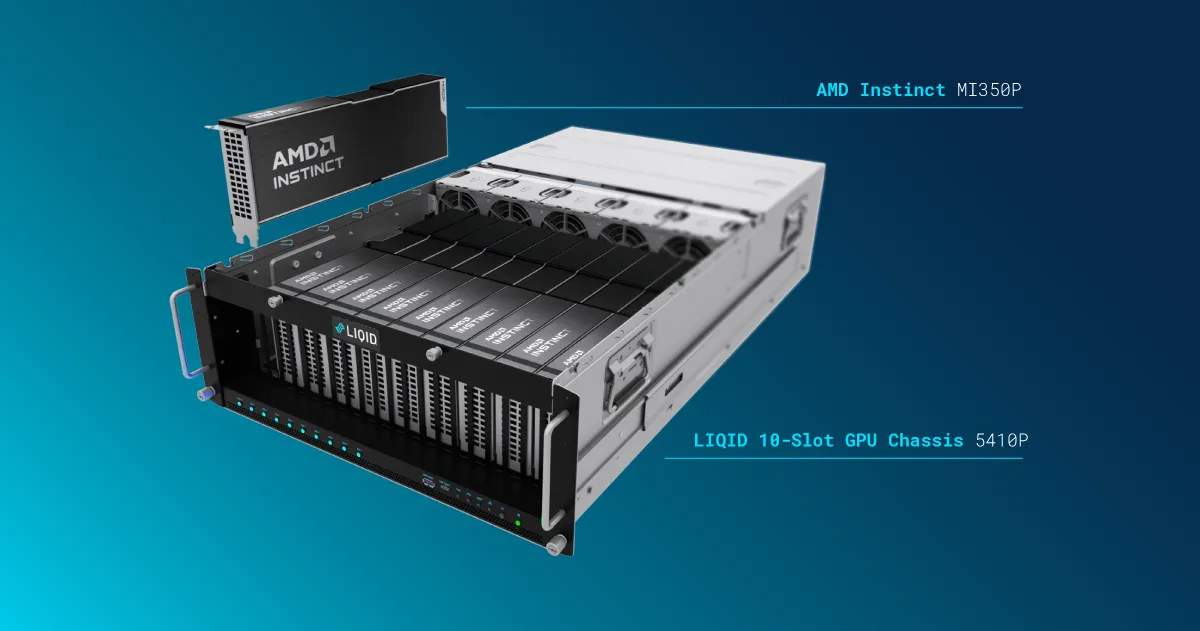
LIQID UltraStack with AMD Instinct MI350P works the same way.
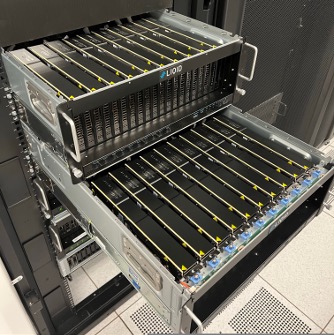
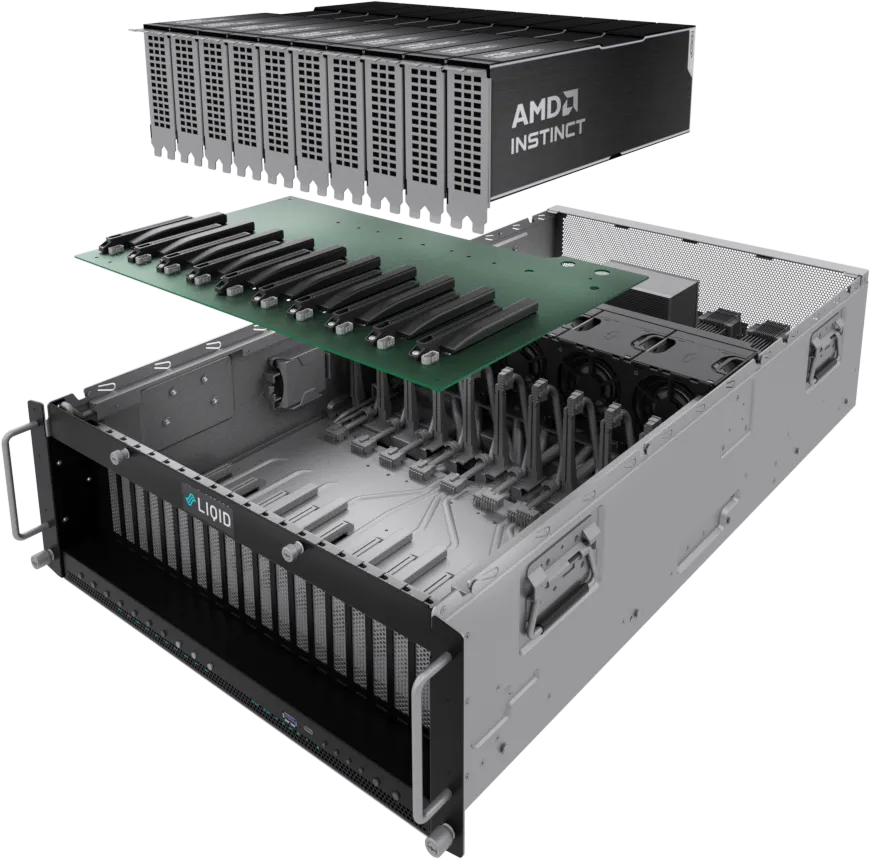
It puts 4 to 30 AMD Instinct MI350P GPUs behind a single dual-socket AMD EPYC 9005 host, connected by LIQID GPU Pooling over a PCIe Gen 5 fabric. One model runs on each GPU. Every card carries 144 GB of HBM3E, enough to hold a model up to the 120B class with room left for its working memory. Nothing shares a card. Nothing waits on another GPU. A 20-GPU system runs 20 models at once.
When you grow, you add stations, not restaurants:
- 4 GPUs (576 GB): one research group, one job, inside your data center.
- 10 GPUs (1.44 TB): every job one team runs, on one server.
- 20 GPUs (2.88 TB): a department’s full set of models, running in parallel.
- 30 GPUs (4.32 TB): an institution-wide private model hub on one host.
Same host at every step. There is no network between the models.
What that looks like for a research team
Here’s a 10-GPU layout built from open-weight models, for a team running literature review and lab data extraction:
- 4 × gpt-oss-120b for reasoning and cited answers across papers and internal reports
- 3 × Llama 3.3 70B for pulling results, methods and parameters out of papers and lab notebooks
- 1 × Mistral Small 3.2 for translating and summarizing foreign-language sources
- 1 × Llama 3.1 8B for routing and triaging incoming documents
- 1 × Whisper-class speech-to-text for seminars, interviews and field recordings
Ten models. Ten GPUs. One server. Your data never leaves the building.
The numbers, and which ones we measured
Here’s what LIQID tested, one model per GPU:
- A 7B-class model ran at 4,653 tokens per second on one GPU, 18,526 on four, 44,383 on ten and roughly 89,000 on twenty.
- A 72B-class dense model ran at 254, 552 and 1,256 tokens per second on 2, 4 and 8 GPUs, under interactive latency limits.
- At 30 GPUs, the 7B-class model comes to about 133,000 tokens per second.
Why does it scale in a near-straight line? Each GPU works on its own. There’s no GPU-to-GPU traffic to wait on, so adding a card adds capacity.
What it doesn’t do
This isn’t a training cluster. It doesn’t split one giant model across many GPUs. Each model lives on one card. If your workload is a large distributed training run, your existing systems are the right tool.
SC26 is about more than the supercomputer
This year’s SC keynote, from Caltech’s Anima Anandkumar, is about AI that understands the physical world. The supercomputer still does the physics. The models around it read, sort, extract, translate and check, so researchers spend their hours on the science instead of the paperwork.
Those models need a home that doesn’t add a row of servers to a center already short on floor space. With LIQID and AMD, that home is one host. A full 30-GPU system draws about 22 kW, air-cooled. No liquid loop. No rack redesign.
Come find us in Chicago
SC26 runs November 15–20 at McCormick Place, and the exhibit floor opens Tuesday, November 17. Find LIQID at booth #5214 to see LIQID UltraStack with AMD MI350P up close, ask the hard questions and map your team’s jobs to models. And look for AMD at booth #3028 for more on the AMD Instinct GPUs.
Bring your job list. We’ll bring the GPU count.
Your researchers already know how to wait for compute. With 20 models running on one server, available now, AI doesn’t have to be the next thing they wait for.
Performance figures for the AMD Instinct MI350P are based on AMD published specifications and are subject to change. LIQID throughput figures are from LIQID internal testing, one model per GPU; the 30-GPU figure is projected from measured 20-GPU scaling. Results may vary by configuration and workload.