Speak With An Expert

Mail icon to contact Liqid about our composable infrastructure technology
Neocloud and Cloud Service Providers

LIQID Memory and GPU Pooling for Neoclouds and Cloud Service Providers

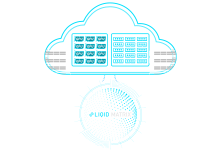
AI demand changes every quarter. Neoclouds and cloud service providers need the ability to scale memory and GPU-as-a-Service (GPUaaS) offerings to deliver inference services and KV Cache offload as differentiated services that accelerate time-to-revenue. Liqid memory and GPU pooling creates an elastic service platform you can re-shape in seconds depending on customer demand and workload.

Request a Federal AI Infrastructure DemoTalk to a Federal Infrastructure Specialist
graphic of neocloud filled with gpu and memory pools
Time to market icon with stopwatch, CPUs and arrows

Demand and Competition Are Creating Massive Pressure for Time to Market and Differentation

The primary challenge Neoclouds and CSPs face: land AI workloads faster than the next provider, at a margin that survives hyperscaler price pressure.

Neoclouds and CSPs must also navigate changing workloads. Training has given way to fine-tuning, RAG, and inference, including  KV cache, quantization, batching, andoffload.

Risk: Demand is No Longer Predictable

CapEx is planned in multi-year cycles, but AI requirements change quarterly. Overprovisioning means stranded capital, but underprovisioning creates latency and performance challenges that limit the ability to compete.

Revenue: New Services Carry Heavy COGS

Between a service idea and a priced, shippable offer, every step removes options. Fixed SKUs, limited space, and power caps shorten the funnel before margin-rich offers reach the market and customers.

Cost: Flexibility From Fixed Hardware is Expensive.

A busy node still hides stranded GPUs, memory, and CPU inside the same chassis. Utilization looks healthy on paper while paid-for capacity sits idle, quietly eroding gross margin.

Built to Get You to Market Faster and Differentiate to Win

close icon
Elastic GPUaaS
  • Offer S / M / L GPU instances from a single underlying poolinstead of one fixed SKU per node.
  • Shift allocations between customers as demand moves, in seconds, with no re-racking.
  • Cut stranded capacity across SKUs and lift fleet utilizationpast 80%.
close icon
Large-Memory Database & Analytics
  • Serve memory footprints that are impossible in conventional servers — up to 200 TB pooled per domain.
  • Target graph, genomics, simulation, and in-memory databases that break out of single-node limits.
  • Offload KV cache and embeddings to pooled DRAM: ~10x cheaper than HBM, ~100x faster than NVMe.
close icon
Adaptive AI Infrastructure Pod
  • Change GPU / memory / compute ratios as services evolve — VDItoday, inference next year, unknown after that.
  • Absorb 12-month workload surprises without re-buying the estate.
  • Protect multi-year CapEx against a market that shifts every quarter.
close icon
Power-constrained AI Expansion
  • Add accelerators where power and space already cap growth, using optimized power and cooling.
  • Phase expansion instead of swapping whole racks — no full estate replacement.
  • Turn constrained sites into new revenue instead of a hard ceiling.

Why Neoclouds and CSPs Win with LIQID

Superior tokenomics
Extreme application performance
Agile infrastructure
Simplified operations
Reduce overprovisioning by scaling GPUs and memory independently. Improve tokens per dollar and tokens per watt.
Increase GPU and memory density per server for inference and KV-cache-heavy workloads.
Provision GPUs and memory directly through familiar orchestration environments such as Kubernetes and VMware.
Full-stack software and hardware, broad HCL, certifications, and major ecosystem support.
Configure resources in seconds, schedule capacity, and defer unnecessary server refreshes.
Proven platform

Memory Pooling

Inference at scale is memory-bound, not compute-bound. The KV cache for a single 70B modelin production can eat 80+ GB of HBM per concurrent stream, every GB spent on cache is a GB you can’t sell to another user.

  • Break the memory wall. Pool DRAM at rack level over the industry’s leading CXL memory fabric, up to 200 TB per domain, allocated per workload instead of over-provisioned per node.
  • Offload the KV cache. Move cache, embeddings, and long context off HBMto pooled DRAM: ~10x cheaper than HBM, ~100x faster than NVMe, ~1000x largerthan HBM. More concurrent users per GPU, lower cost per token.
  • New premium categories. Large-memory inference, KV-cache-optimized hosting, RAG hot tiers, and vector DBs on pooled CXL, SKUs hyperscalers can’t undercut on raw GPU price.

GPU Pooling

GPU utilization is an allocation problem, not a scheduling problem. Accelerators are bolted to a chassis at purchase and stay there for a five-year refresh cycle, every GPU stranded in the wrong box is a GPU you can't sell to the next tenant.

  • One pool, every generation. Hopper, Blackwell, and AMD MI350P in the same PCIe pool. Up to 30x GPU device pools for unmatched performance and agility, while driving efficiency.
  • Utilization becomes a differentiator. Move from 40–60% on static clusters to 80%+, the same GPUs, billed against more workloads.
  • Allocation in seconds. 1–30 GPUs on demand delivered via software that’s native to Kubernetes, Slurm, and custom schedulers.
  • Fewer servers, same capacity. Up to 75% fewer servers for the same usable output.

Ready to Improve Your Economics?

See how Liqid can help your team pool GPU and memory resources, increase utilization, and deploy secure on-prem AI, HPC and, other data-intensive workloads with the infrastructure ecosystem you already trust.

Request a demo