


Abaco is a memory-centric rack architecture built by Micron and powered by Liqid for AI and HPC workloads that run out of memory long before they run out of compute. Liqid provides the memory fabric, the chassis, and the software that turn a rack of DDR5 into a pool that the server can claim and release on demand. The U.S. Department of Energy’s Pacific Northwest National Laboratory is the first deployment.
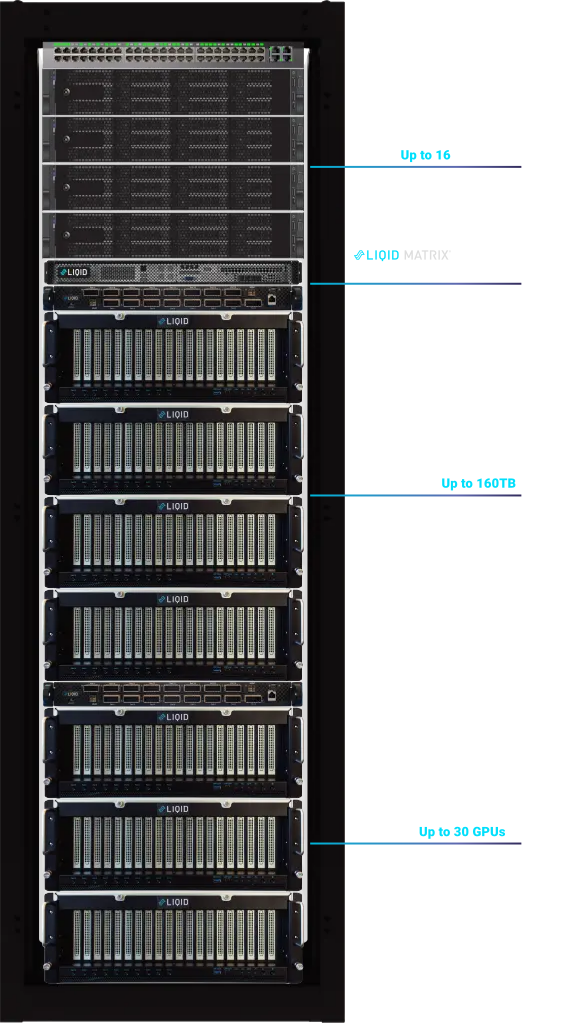
Abaco is a shared-memory system architecture for AI and HPC, designed by Micron with Liqid as the memory fabric and orchestration partner. A single Abaco rack presents up to 160TB of DDR5 as an addressable pool that one or multiple hosts in the rack can claim, share, or release without a reboot and without re-cabling. Applications reach the pool through a standard file system interface, so most code runs unmodified.
Compute, storage, and networking all became poolable resources. Memory did not. It stayed locked in the server with the CPU socket, sized at purchase, and stranded there for the life of the server.
That leaves two failure modes. Capacity sits idle in one server while the server next to it pages out to NVMe. And a class of workloads never runs well anywhere, because no single server provides enough directly addressable memory.
AI made both problems worse. KVcache for long-context inference, vector and graph indexes for retrieval, and the intermediate data in AI-assisted simulation all grow faster than HBM capacity or per-socket DIMM slots. Buying more HBM to hold cold cache is the most expensive way to solve a capacity problem.
“For several decades, the HPC community has focused on distributed memory system architectures, and while many applications can be partitioned to make use of memory that is directly attached to processors, it has led to ‘orphaned’ applications that require large directly addressable memory capacity.”
James A. Ang, Ph.D., Chief Scientist for Computing, Pacific Northwest National Laboratory
An Abaco rack is five layers:
Compute, fabric, memory, GPU, and software.





Micron supplies the DRAM and integrates the system. Liqid supplies the part that makes a large pool of DIMMs behave like a resource instead of an inventory item: the chassis that holds it, the fabric that reaches it, and the software that assigns it.


Expanding memory is one problem. Letting several hosts work on the same resident dataset is a harder one, and it is where Liqid and Micron built something that did not exist before: the industry’s first architecture supporting true memory sharing.
famfs is Micron’s fabric-attached memory file system, contributed as open source to the Linux kernel. It presents the disaggregated Liqid pool to the host operating system as a file system, with software cache coherence across hosts. Two consequences matter for anyone sizing a system:
Code that already reads files reaches pooled memory through the same interface. Most applications need no changes at the application layer.
Hosts share a dataset in place instead of each pulling its own copy, which cuts data movement and removes the storage round trip for large working sets.
Benchmark systems run RHEL with kernel 6.14.11, weighted software interleaving enabled, and the famfs kernel updates applied.
Micron lab testing on representative workloads, using production hardware and software:
Additional gains are expected as the platform adds features and the software stack matures.
PNNL’s memory-centric program began with Crete, a 15TB active-memory testbed that came online in August 2025, an amount of RAM equal to 240 high-end laptops running and communicating at once. Abaco scales that approach by more than an order of magnitude.
Micron is prime contractor and system integrator. Liqid provides the scale-up memory pool that exposes hundreds of terabytes of coherent active memory to data-intensive AI for Science workloads. The first user-facing application is AI-integrated computational chemistry:
The testbed is available to DOE-funded researchers at national laboratories and universities through the Advanced Memory to Support Artificial Intelligence for Science (AMAIS) initiative, funded by the DOE Advanced Scientific Computing Research program within the Office of Science.
“PNNL and Micron have built something singular: a memory-centric system designed for the workloads that could define the next decade of AI for Science. Liqid is honored to extend that platform with the scale, orchestration, and composability that turn pooled memory into a programmable resource. This is what tokens per dollar and tokens per watt look like in a national laboratory environment.”
Sumit Puri, Founder and CTO, Liqid
Get the two-page technical brief, or bring your workload and memory footprint to a briefing with the Liqid team.

LIQID’s innovative software-defined pooling solution platform enables users to manage, scale out, and configure physical bare-metal server systems in seconds.


