
Campus-wide private AI on AMD Instinct™ MI350P.Every lab gets its own model on one LIQID UltraStack server, with research data kept inside your data center.
Keep private AI with one research center, or scale it to every lab without building a cluster.
Departments ask for private model access at the same time.
Grant money and protected data drift to public APIs.
Lab-owned servers sit idle while other labs wait.
Multi-node builds need GPU networking, switches and staff.
IRB protocols and data use agreements bar public AI APIs.
Every coded theme has to link back to its source.
One 10-GPU LIQID UltraStack server runs a campus research AI service. Each lab or project gets a full GPU with its own model, and GPUs move to new projects each term or grant cycle.
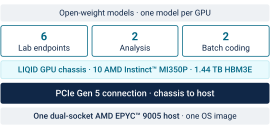
gpt-oss-120b, one full model per GPU, assigned to a lab or project.
Llama 3.3 70B codes themes and summarizes, citing the source.
Llama 3.1 8B labels survey and free-text responses at volume.
No cluster, no idle silos: one host, ten GPUs, a model per lab, and room to grow to 30.
Add GPUs and a new job, not a new cluster.
One GPU per lab or project, reassigned each term or grant cycle.
6 × gpt-oss-120b lab endpoints · 2 × Llama 3.3 70B analysis · 2 × Llama 3.1 8B batch coding
CIO / Director of Research Computing. Labs asking for AI; unsanctioned API use on grants.
Grant compliance review, export-control screening and proposal drafting.
6 × 70B proposal and compliance review · 4 × 8B export-control screening · 10 × lab endpoints and analysis
VP Research / Sponsored Programs. Proposal volume; review backlog.
Research, administration and teaching on one host.
14 × lab endpoints and analysis · 10 × research administration · 6 × gpt-oss-120b courses and coursework
CIO / Provost. Consolidating departmental AI; teaching demand.
Two questions settle the size of the opportunity: how many labs are asking for AI today, and how many hold data they can't send to a public API?
*Efficiency targets compare against multi-server deployments of the same GPUs; they are LIQID internal projections using AMD published specifications, and results vary by configuration and workload.
Performance figures for the AMD Instinct MI350P are based on AMD published specifications and LIQID Phase-3 testing from 1 to 20 GPUs, and are subject to change. 30-GPU figures are projected from measured 20-GPU scaling. Every layout runs one model per GPU; 20- and 30-GPU layouts are sizing arithmetic on published model sizes, not benchmark results. Models shown are US and EU open-weight models. Outputs support, and do not replace, researcher review. Institutions remain responsible for IRB, data use agreement and export-control compliance.