
LIQID UltraStack with AMD Instinct™ MI350P GPUs
Add a GPU. Add a model.LIQID UltraStack with AMD Instinct™ MI350P runs one model per GPU, with throughput that scales linearly to 30 GPUs on one AMD EPYC™ server: measured to 20, projected to 30.
The LIQID GPU chassis holds 4 to 30 MI350P cards over PCIe Gen 5, pooled behind one dual-socket AMD EPYC™ 9005 host. Every GPU stays in one node, so there are no network hops between GPUs and nothing waits on another card.
LIQID Phase-3 testing on AMD Instinct MI350P, one host, AMD ROCm™ software.
Each GPU runs its own model, so nothing waits on another GPU. Measured linear to 20 GPUs; the same line reaches ~133,000 tok/s at 30.
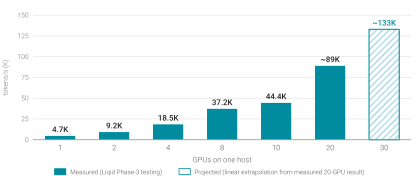
The same host at every step: add GPUs, add models.
Small and mid-size model fleets scale with every GPU.
A 72B-class model held latency targets as GPUs were added.
144 GB of HBM3E holds the model and its cache.
Every model below fits on one MI350P with room for its KV cache.
The fastest proof is your own workload: which jobs, which models, and how many users at once? Bring us three numbers and we will size it in one working session.
Performance figures for the AMD Instinct MI350P are based on AMD published specifications and LIQID Phase-3 testing from 1 to 20 GPUs, and are subject to change. 30-GPU figures are projected from measured 20-GPU scaling. Every configuration runs one model per GPU. Models shown are US and EU open-weight models. 7B-class: 4,653 tokens/s on 1 GPU, 9,193 on 2, 18,526 on 4, 37,216 on 8, 44,383 on 10, ~89,000 on 20. 72B-class: 254 tokens/s on 2 GPUs, 552 on 4, 1,256 on 8. Tokens per hour = tokens/s × 3,600. AMD Instinct MI350P specifications: 144 GB HBM3E, ~4 TB/s, ~2.3 PFLOPS FP8, 600 W (AMD published).