Solution Brief
Sovereign LLM-as-a-service. Grow by the GPU.

Sell tokens,not idle GPUs.

Sovereign LLM-as-a-service on AMD Instinct™ MI350P.A three-tier model catalog with per-tenant endpoints on one LIQID UltraStack server, in your facility and jurisdiction.

10
GPUs
MI350P on one host, room for 30
1.44
TB
HBM3E on one server
3
tiers
fast, balanced and premium
0
hops
network hops between GPUs

The Capacity Dilemma

Bet on a GPU cluster before tenants sign, or miss the demand for private endpoints.

Demand Pressure

Customers want private endpoints

In-country LLM endpoints their data never leaves.

Demand shifts by tier

Fast, 70B and reasoning traffic rise and fall at different times.

Capital Pressure

A cluster is a big bet

Large GPU clusters come before paying tenants do.

Peak sizing sits idle

Buying for peak leaves capacity unused most of the day.

Sovereignty Pressure

Data stays in-country

Tenant data has to stay in your facility and jurisdiction.

Every tenant is isolated

Each one gets its own endpoint and API keys.

Serve It. Meter It. Grow It.

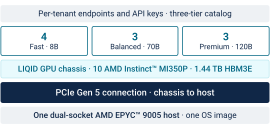
One 10-GPU LIQID UltraStack server serves a three-tier catalog: a fast small model, a balanced 70B and a premium reasoning model. Each tenant gets its own endpoint, and each tier runs on its own GPUs, one model per GPU.
  • Sell tokens, not idle GPUs
  • Low starting risk: one server, not a cluster
  • Grow from 10 to 20 to 30 GPUs on the same host
GPU allocation for a three-tier catalog with per-tenant endpoints and API keys: 4 GPUs fast tier (8B), 3 balanced tier (70B), 3 premium tier (120B), on a LIQID GPU chassis with 10 AMD Instinct MI350P and 1.44 TB HBM3E, connected over PCIe Gen 5 to one dual-socket AMD EPYC 9005 host with one OS image.

Fast Tier · 4 GPUs

Llama 3.1 8B replicas serve the low-cost, high-volume tier.

18,526
tok/s, 7B-class, 4 GPUs
44,383
tok/s, 7B-class, 10 GPUs

Balanced Tier · 3 GPUs

Llama 3.3 70B, one full model per GPU, for general-purpose endpoints.

1,256
tok/s, 72B-class, 8 GPUs
1 GPU
per 70B model at FP8

Premium Tier · 3 GPUs

gpt-oss-120b, one model per GPU, serves the reasoning tier.

144 GB
HBM3E per MI350P
1 card
holds gpt-oss-120b
Measured results: LIQID Phase-3 testing on 1 to 20 MI350P GPUs on one host. Test conditions and notes on page 2.
LIQID UltraStack with AMD MI350P for Cloud Providers

Proof: Measured on MI350P

No cluster bet: one server, three tiers, and capacity that grows with paying tenants.

Result
What was measured
Why it matters here
18,526 tok/s
on 4 GPUs, 7B-class
FP4, one replica per GPU, fixed concurrency of 128
High-volume fast tier on a fraction of the server
3.98× scaling
1 to 4 GPUs, 7B-class
Near-linear from 1 to 4 GPUs; 44,383 tok/s at 10 GPUs
Every GPU you add is capacity you can sell
552 tok/s
on 4 GPUs, 72B dense
FP8 under interactive limits: P99 TTFT ≤ 2 s, ≥ 30 tok/s per user; 1,256 on 8 GPUs
Balanced tier at interactive speed for every tenant
What it means
Capacity matches paying demand
Grow by the GPU, not by the cluster
Two tests, different conditions: the 7B-class run (FP4) used fixed concurrency of 128 with no latency gate; the 72B run (FP8) reports throughput at the latency-gated knee. Don't compare them directly. Source: LIQID Phase-3 testing. gpt-oss-120b, Llama 3.3 70B and Llama 3.1 8B performance is projected from same-class results and has not been measured directly.

Grow on the Same Server: 10, 20 and 30 GPUs

Add GPUs and a new job, not a new cluster.

Start here
10
GPUs
1.44 TB HBM3E

Sovereign three-tier LLM catalog

Fast, balanced and premium endpoints with per-tenant API keys.

Model layout

4 × Llama 3.1 8B fast tier · 3 × Llama 3.3 70B balanced tier · 3 × gpt-oss-120b premium tier

Who buys, why now

Neocloud / CSP product lead. First tenants outgrow a 4-GPU starter.

20
GPUs
2.88 TB HBM3E

Dedicated tenant endpoints

Shared tiers plus reserved GPUs for enterprise tenants that want dedicated capacity.

Model layout

10 × shared catalog tiers (8B, 70B, gpt-oss-120b) · 10 × dedicated tenant models, one per GPU

Who buys, why now

VP Product / GM, AI cloud. Enterprise tenants asking for dedicated, in-country capacity.

30
GPUs
4.32 TB HBM3E

Sovereign catalog plus dedicated tenants

The full catalog plus dedicated tenant models, in your jurisdiction.

Model layout

10 × catalog tiers (8B, 70B, gpt-oss-120b) · 20 × dedicated tenant models, one per GPU

Who buys, why now

CTO / sovereign cloud program. Customers want sovereign AI without a hyperscaler.

Starting smaller? The 4-GPU starter catalog runs one model per GPU, one GPU per tier.

What UltraStack Adds

  • One model per GPU: 144 GB HBM3E holds a full 70B model at FP8, or gpt-oss-120b.
  • No network between GPUs: peer-to-peer over PCIe Gen 5 to one EPYC host.
  • Air-cooled: about 22 kW for the full 30-GPU system.

Start Fixed, Grow on One Host

  • One host: one OS image, one license footprint, one thing to patch.
  • Room to grow: 10 to 20 to 30 GPUs on the same host.

What Is Proven Today

  • P2P bandwidth saturates the link; RCCL collectives pass, 1 to 10 GPUs.
  • ROCm integration complete, developed jointly with AMD.
  • 200+ production deployments, 85+ patents.
The Efficiency Case · Targets, not measurements*
75%
Up to 75% fewer servers
2.1×
Up to 2.1× more tokens per dollar
1.8×
Up to 1.8× better tokens per watt
50%
Up to 50% lower power

Bring Us Three Numbers

Two questions settle the size of the opportunity: how many tenants want private endpoints today, and which models do they want?

1
Tenants:

committed and in the pipeline.

2
Mix:

share of fast, 70B and reasoning traffic.

3
Peak:

concurrent users and tokens/sec at peak.

Built for

Neoclouds · Cloud service providers · Sovereign cloud · Managed service providers

Proven on

AMD Instinct™ MI350P · AMD EPYC™ 9005 · ROCm™ · 200+ LIQID deployments

*Efficiency targets compare against multi-server deployments of the same GPUs; they are LIQID internal projections using AMD published specifications, and results vary by configuration and workload.

Performance figures for the AMD Instinct MI350P are based on AMD published specifications and LIQID Phase-3 testing from 1 to 20 GPUs, and are subject to change. 30-GPU figures are projected from measured 20-GPU scaling. Every layout runs one model per GPU; 20- and 30-GPU layouts are sizing arithmetic on published model sizes, not benchmark results. Models shown are US and EU open-weight models.

Speak With An Expert